Wednesday, January 10, 2007

Shopping in France Part Two: Les Soldes

In French, des bonnes affaires means "some good deals". For example, you might say: j'ai trouvé beaucoup de bonnes affaires pendant les soldes d'hiver, (I found a lot of good deals during the winter sales).
I was at la Part-Dieu yesterday and noticed that it was eerily empty. If I have noticed anything about "the mall" it is the one place that has made me feel the most "at home", meaning that it is usually crowded with pushy people carrying three or four shopping bags and annoying in-the-way clusters of teenagers occasionally dekeing people out. However, after looking in the stores where numbers of employees were cordoning off racks of clothes sometimes covered in sheets of plastic, each piece of clothing tagged with a huge coloured rectangle or circle printed with -50%, I soon realised: LES SOLDES!!! were coming...

Today is the first day of les soldes (the sales), when retail merchandise is marked down even 70%. In France, the government regulates sales and forbids stores to have periodic major markdowns after each season, like we are used to in Canada throughout the year. Thus, every year, the mairies of each department get together to determine the nation-wide dates of the sales and how long each will allow the stores to hold their sales (the maximum being six weeks). And so, twice a year (in January and again in June), stores are given the chance to get rid of all of last season's stock, and shoppers go nuts.

If shopping is your thing, this is the time to do it. I've been told that it's worth the wait because something that might have been 80€ can be bought for fifteen or twenty during les soldes.

In your face 2€ coffees, I'm mindlessly blowing my money elsewhere these next few weeks!
Read more...

Monday, January 08, 2007

Exams

The exam period at Lyon 3 occurs between the end of classes until the beginning of the new semester. The summer exams occur from the end of classes until the end of June.

Sweaty palms, rapid drop in body temperature, dry mouth, fluttering stomach, nervous coughs in poorly-ventilated rooms, intellectual black-outs... The previous are commonly my experience during exam time and this does not bode well for my success in the French system.

Taking Your Exam as an Exchange Student
The time and place of your exam is usually posted up the day before or the morning of your exam on the corresponding boards of your faculty. Be sure to consult these lists because there is assigned seating. The exam period at Lyon 3 occurs between the end of classes until the beginning of the new semester. The summer exams occur from the end of classes until the end of June.

As an exchange student in the law faculty, if it is not already written on your exam, you will be given stickers by Annie Simon - the secretary of the law faculty - that you can stick on the front of your exam (I'm assuming that outside of law, you go see the secretariat of whichever faculty is responsible for the majority of your courses).
Even though it's readily apparent that you are an exchange student, sometimes, there are foreign students who are studying in France, not on exchange, who also have bad grammar but are marked at the same level as French students. You, however, are a foreign student on exchange and thus not marked as harshly for your grammar and spelling mistakes. It's better to get the stickers.

Equal = Anonymous
In France, there is an equality rule in place that is particularly strict when it comes to exams. You are not to write your name on any other part of the exam except in the designated space at your top right hand corner, after which you fold and glue shut. Your name is revealed only after the grades are finalised.

I'm not sure how this affects exchange students but in France, since the education system is an organ of the Republic (like the health system, like the army, like the police....), if a student is caught cheating or plagiarising, s/he is automatically barred from taking any sort of exam (this includes driving exams, entrance exams for other schools) for five years.

Le carnet de notes
You are asked to bring with you to each exam a booklet (carnet de note) for your professor or the invigilator to fill out, which you then hand in to your faculty before leaving. This is where all of your grades will be recorded and then mailed to you or your school.

On a final note, I've been told that while exams are a supremely stressful time for French students (I've been told that France has one the highest failure rates in the Union), as an exchange student, you need not be as worried because they understand that things are more difficult for you. As long as beneath the bad grammar and spelling mistakes you reveal a fundamental understanding of the course material, you should be fine.
And when that doesn't happen... It was nice living in France for a while, wasn't it?
Read more...

Sunday, January 07, 2007

Really Caveat, Emptor: Shopping in France

I recently watched the movie A Good Year (or Une grande année) with Russell Crowe and Marion Cotillard (she will also be seen very soon, February 14 to be exact, in La môme a biopic on the life of Edith Piaf) in which Cotillard's character - the owner of a café in Provence - offered this bit of advice to Crowe: "in France, the client is always wrong". And you really can't imagine how true, and not funny, that is.

A good rule to have when shopping in France is not to buy anything you aren't 100 percent sure about (really, a good rule anywhere), because the chances are that you will have a hard time returning it if you discover that you aren't entirely satisfied. Don't pay any attention to what it says on the back of receipts because it doesn't mean anything.

I bought a cell phone a few weeks ago and upon discovering that it was entirely the opposite of what the salesperson assured, naturally, I wanted a return. Since the back of the receipt stated clearly and separately that in the case of returns for pre-paid cell phone packages, the product is accepted minus the cost of the SIM card. I was looking at receiving a fraction of what I paid but I still returned the next day intent on a refund or exchange. Unfortunately, all I got was condescension and rejection.

Apparently, contrary to what it states on the receipt, it is "impossible" for them to accept returns for pre-paid cell phone packages because the SIM card is attached to the phone. Totally bogus answer because everyone knows that the SIM card can be removed and put into any phone. However, the girl behind the counter sensed that I was not satisfied, but seemed to have felt that her answer was enough, and left me to attend to another customer.

On a homesick note, my French roommate told me about how surprised she was by the ease of returns of purchases in Canada. She had bought a tent at Canadian Tire and upon discovering that it was of terrible quality and not warm at all, she returned to the store completely prepared to be forced to justify her case. Needless to say she was more than pleasantly surprised (and totally shocked) by the fact that the cashier took the tent upon presentation of the receipt and asked no questions This does not happen in France was her conclusion on this cross-cultural consumer difference.
Read more...

Wednesday, December 13, 2006

Medical Visit with "Dr. de Lyon"

You can avoid the medical visit by going for a checkup with one of the doctors approved by the consulate in your own country before your arrival.

Today, I went for my scheduled medical checkup at the A.N.A.E.M (Agence Nationale de l'Accueil des Etrangers et des Migrations). The prefecture made the appointment for me and I received a letter in the mail with all the particulars.

The ANAEM is located at 2, rue quivogne in the 2e arrondissement. I got off at Perrache station and walked south, past the Prison. This medical checkup is mandatory for any foreigner legally staying in France for more than three months.

I learned:
-Bring it, if you have an updated booklet of your vaccinations.
-If you wear glasses, make sure you bring with you either an extra pair of glasses or your prescription. There is a three month waiting list to see an ophthalmalogue.
-There are also waiting lists for dentists. The doctor suggested that for non-serious matter, such as check-ups or cleanings, to see the dental students located near the Institut d'Etudes Politiques on ave Berthelot.
-AIDS tests are free and confidential for everyone.
-There is a vaccination centre on Rue de Marseille in the 7e.

Click on the link to create a search in greater Lyon for medical treatments by theme (site in French).
Read more...

Thursday, November 30, 2006

One Semester-Travelling in the Schengen

If you are staying for less than a full year, you might have gotten the message dispense de carte séjour this just means that you are ineligible for the residence permit.

I want to travel a bit after my semester, can I?

I have a Canadian friend who is living in Belgium for three months after which she is legally required to leave the Schengen zone for at least three months before she can return.

Schengen ≠ EU

While there are political, social and economic reasons for this treaty, the important thing for the traveller to know is that it essentially means free travel between all fifteen countries (with new countries joining) without worrying about border checks and special visa applications, you just need one "Schengen visa." That being said, sometimes they do check for ID. Canada is among the countries that do not require a special Schengen Visa in order to enjoy free travel throughout the zone but...

Here are the few restrictions for Canadians that do exist:

With your passport, you are permitted 90 days travel per every 3 months and 180 days per 12 months. What this means is that you can stay in any one country or travel between all fifteen countries continuously up to 90 days, after which you must leave the region for at least another 90 days (note, the UK and Ireland are not Schengen countries) before you can return. However, from what I've read, the most important portion of the time restriction is the 90 days, and not necessarily the per 180 days. I think this stuff is meant to confuse people.

For example, you arrive in Germany and stay for 10 days and then move on to Belgium for 5 days and then move on to France for another 15 days, thus, 10+5+15 = 30 days total in the Schengen zone. You decide that rather than go to Switzerland as planned, you choose Scotland for a month and a half - not Schengen. When you leave France, you get your passport stamped showing that you've left. After a week, you realise that it's wet and boring and decide to make your way back across the channel to walk your troubles away along the canals of Amsterdam. Enter Schengen again, stamp on your passport and the countdown re-starts.

What happens if I travel throughout Schengen if it's past 3 months?

I'm not sure what exactly happens to you. The official penalty is that you get deported, and barred from coming back for a certain amount of time, but I'm not sure how strictly that's enforced.

In conclusion...

The reps from the consulates and embassies of the countries you want to visit can not be relied upon to give you correct information. They are usually specialists in affairs affecting their own citizens, and not necessarily of foreigners in their countries. From my friend's experience, everyone is a bit wishy washy, and honestly, it's much easier to rely on the advice of friends and the good ol' internet.
Read more...

Friday, November 17, 2006

Toilets - Not for the squeamish

One day, Marcelle let me know that a common bug that makes its rounds in the winter months in France, is some sort of gastro thing that you can be sure to catch if you make frequent use of public toilets.

Toilets are never free in train stations and airports and cost about 0,50€, which you pay to an attendant.

In Lyon, most of the street toilets are free. Some of them have specific times when they are free and at other times, they may cost you anywhere from 0,15-0,50€. And, honestly, it's hardly ever worth it. Some of these toilets were downright nightmarish and makes me question my euro-centric education even more, chiefly the idea of Europe being the "centre of civilization" or whatever.


(Source: stylebytes.net)


The regular occurence of co-ed toilets in this country reminds me habitually of my prudishness. A few of the toilets at the Lyon 3 campus are co-ed. I must admit that even after three months, I still have trouble killing the instinct to turn around and find the "right" ones when I walk into the toilets each morning and find four male behinds lined up against a wall.

The toilets in Lyon are also frequently found without toilet seats and I'm not mixing toilets up with urinals. I suppose it's fine when you only need to squat, but there are certain times when squatting can't comfortably take the place of a paper toilet seat cover, if you know what I mean.


Proceed with caution.
Read more...

Thursday, November 16, 2006

Beaujolais Nouveau

The French expression for partying is faire la fête (direct translation: to make party).
By French law, the new crop of Beaujolais nouveau cannot be released earlier than the third Thursday of November of each year. However, due to the wild popularity of the wine with the Japanese market (and the yen that can be made by this special exception), technically, it is released eight hours ahead of French time in Japan.
As the date approaches, you will see posters and flyers in the windows of bars and cafés signalling the approach of the date and planned on-site tastings.

Beaujolais: The region
The Beaujolais region is located north of Lyon and is widely known as a wine producing region. Every year, the International Relations department at Lyon 3 organises a Beaujolais nouveau-tasting trip out to the region for exchange students.


(Source: www.exquisine.de)


Beaujolais Nouveau: The wine
I know little about wine and my palette is not the most refined but I have learned a few things in passing about this wine. Beaujolais nouveau is one wine produced in the Beaujolais region and one of its most popular. The most occasional wine enthusiast will tell you that Beaujolais nouveau is not the best wine, being more "commercial" and cheaper. Unlike many other red wines that taste better as it ages, Beaujolais nouveau is meant to be drank quickly (i.e. it does not keep well and not that it needs to be chugged).
Read more...

Monday, November 06, 2006

The Library

The understatement of the century would be for me to say that the one library at the Lyon 3 - Manufacture de tabacs campus pales in comparison to UBC's library resources. Can you also believe that there's, like, no elevator in this library? I have now experienced going back in time.

One of the bigger libraries in Lyon is le Part-Dieu but it is also by no means something to write a postcard home about. I got a library card on Saturday: borrowing books is not free.
Paper alert: To get a library card, you need to bring: a piece of ID, a justificatif de domicile, your student card (to take advantage of better rates) and money.

I remember a French professor telling us once how spoiled university students were in Canada, and made a reference to our library privileges and access to resources. Granted, the average UBC student pays about two-hundred times what the average French student pays for tuition. Nevertheless, sucks sucks. Although, our higher tuition price doesn't explain why we get to borrow almost any book we want from the public library and bring them home to read while on the toilet, all for free!
Read more...

Sunday, October 29, 2006

Sunday

Faire la grasse matinée is the French expression for "sleeping in". See linternaute.com for an explanation of this expression and its origins.
Even though the fight for Sunday shopping in Canada happened in my lifetime, I can't remember life before Sunday was just the day before Monday (except, I think, in Newfoundland). Since my second French Sunday, I have grown fond of this day of forced relaxation and mini break from excessive consumerism.

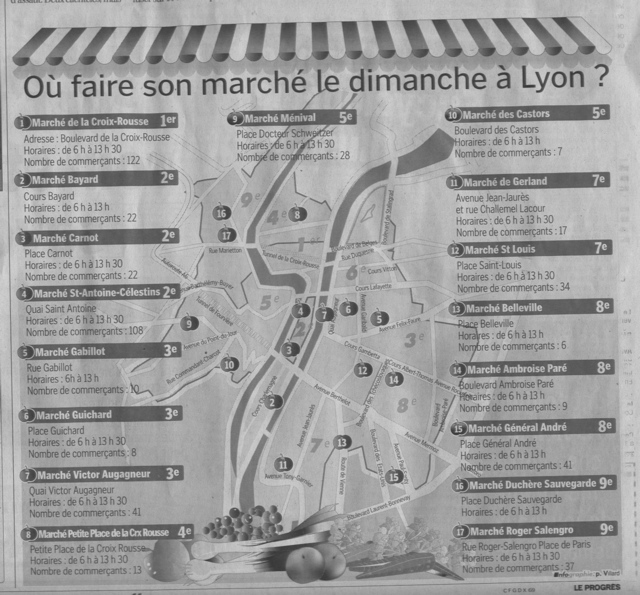
In Lyon, virtually everything is closed Sundays. Sunday is a day when people relax and enjoy leisure activities, along with taking a stroll in the park, seeing friends, or going to the cinema, another favourite Sunday activity is going to the market for fresh, local produce. There is at least one market in every arrondissements.

I came across this helpful little list of all the Sunday markets in this Saturday's Le progrès and felt it useful enough to post:

(Le progrès, samedi le 28 octobre 2006, p 11)

Bon dimanche à tous!
Read more...

Wednesday, October 25, 2006

Wifi in Lyon

The French pronunciation of Wifi sounds like 'weefee'. Hifi, however, is still pronounced like 'highfye'.
The particular thing about Lyon and perhaps France in general is that while Internet is widely used, carrying around your laptop and opening it in a café, or restaurant, or wherever it may be, is not as prevalent as it is in, say, Vancouver.
But sometimes, if you are lucky, you might be able to find an open connection.

I am happy to report that the Lyon 3 (and probably the other campuses) campus is Wifi enabled! But, you need a student number and password to access it.

I located a few sites that listed paying and non-paying wireless hotspots before I came but a few of the non-paying ones were gone or closed down. Bar none, for the technologically mobile (and not totally savvy), the best place for Wifi is almost any McDonald’s. You have unlimited access as long as you buy something. A cheeseburger is 0,95€.

Here are some things that I just found that I haven't read through yet but look interesting:
Windows users you can check the site wireless-lyon to connect to a proxy site. I have a Mac so I didn't bother reading through it.
Also, looks like this organisation Wifi-Lyon has something interesting going on. Worth looking into if just so that you don't leave after an internet session smelling like fry-oil.

On an un-Lyon related note, the restaurant on the ground level at Gare de Lyon in Paris provides free wireless for half an hour. Just sit on one of the benches near it.
In 2006, the mairie of Paris embarked on an ambitious project to make Paris wifi-enabled, including cutting taxes for companies that install fibre-optic cables, and allowing internet service providers to install antennae on strategic public locales. Currently, all public spaces in Paris are said to be Wifi enabled, i.e. parks, museums. To find open connection sources by arrondissements (district), check this link: Localisation des bornes Wi-Fi from the Mairie de Paris' website.

While I'm at it, here's a link to Londonist's map of Wi-fi hotspots in the eponymous city.
Read more...

Sunday, October 15, 2006

Le Petit Paumé

Hi hi! When you are in Lyon, don't forget to get your copy of Le petit paumé. An impressive little student guide to gastronomy and fun, and also includes essentials such as "Ouvert les dimanches" and "Pain-Vin-Fromage".

This guide has been available every October for, apparently, the last 38 years, and is made possible through the volunteer efforts of 23 students from l'École de Management de Lyon and ad funding.

This year's petit paumé is 432 colour pages (500 g) of conversational-style advice on cheap eats, good eats, clubs, bars, banking, health, internet cafes, printing shops... Basically all things that are indispensable to a student's life. Read more...

Saturday, October 14, 2006

Mussels/Moules/Musselens in Brussels/Bruxelles

Christine tells me that they say à tantôt! in Belgium for "see you soon!"
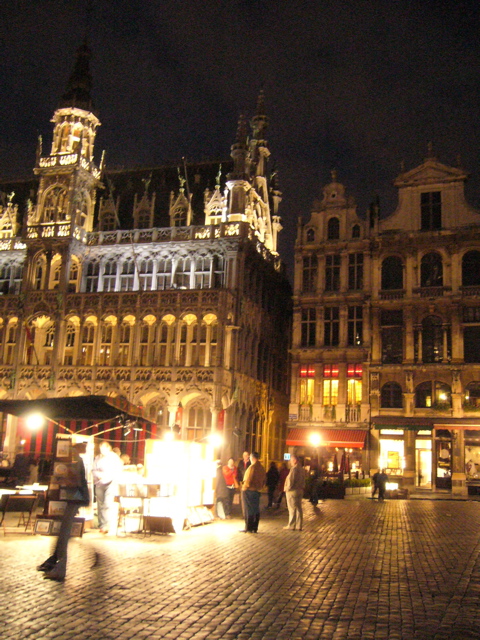
Taking a break in Brussels right now for a weekend visit to one of my favourite persons in the whole world, Christine.
Brussels is approximately 3.5 hours away from Lyon by direct train, and approximately 6 hours if you take the TGV into Paris and then catch a Thalys train into Brussels (the lengthier trip is slightly cheaper).

I've been told that travelling around Belgium is quite cheap and definitely more so than around France. I have little experience with this, but a trip from Brussels to Antwerp (a 1.5 hour journey) was about 6€ - return, and I do know that travelling from one cool city to another cool city in France is at least four times that.
From what I've noticed, Brussels also seems to be a centrepoint for travel and connected to many destinations by land and air.

Things that you must try in Belgium that are not overrated:
The fries, with one of those mayo dips. There's something about the mayonnaise dip that's not gross but a bit sweet and damned delicious!

Waffles. Crispy, fluffy, and warm sweetness... Waffles with nutella... Waffles with strawberries and cream... Waffles with ice cream... My sliced banana/chocolate waffle was so good, I could have made out with the guy that sold it to me.

Moules-frit
es. We ate a bucket of mussels, cooked in white wine, with a side of fries and mayo dip. However, if you hate mussels, this won't be any good at all.

Beer. Christine brought me to a bar in Brussels called Delirium that had over a thousand variety of beers. I don't really condone stereotyping based on gender but occasionally, coincidences happen. Christine and I happen to be female and we both happen to like flavoured beer. She had coconut flavoured beer that was extremely enjoyable. I had a banana-flavoured beer that was actually good, so not as disgusting as it might seem.

The chocolate. Even the chocolate that you buy at crappy grocery stores in the train station are melty delicious.

Things I learned:
A weekend is way too short a time to spend in Belgium... Everybody will tell you to go to Brugges, sometimes also referred to as "the northern Venice"... Belgium is an officially bilingual country, the two languages being Flemish and French. I've been told that most Flemish speak French and not so much the other way around... I've also been told that people in the Flemish parts don't really appreciate it when you speak French to them... Bruxelles (the French name for Brussels) is pronounced like brue-sell and not bruek-sell... The official type of government is a federal parliamentary representative democracy with a monarchy. But because of the historical problems between the Flemish and the French-speaking communities, along with its membership in the EU, Belgium has a very complex (some say convoluted) number of political institutions with multiple responsiblities... Brussels' red light district is right outside of Brussels Nord train station. Lingerie clad ladies hang out in the storefronts and make sexy faces and gestures so that men will come in... There are three train stations in Brussels - South/Midi/Zuid, Central/Centrale/Centraal, and North/Nord/Noord... I really liked seeing everything in two languages which reminded me of home, except Dutch is way cuter looking than English...
Read more...

Wednesday, October 11, 2006

Class Notes

A VERY SHORT LESSON IN FRENCH STUDENT SHORTHAND:

càd = c'est-à-dire
cô = comme
d/s = dans
e/t = entre
ê = être
qd = quand
Org°, C° = organisation, Constitution (a ° will designate most words ending in "ion". Additionally, sometimes a superscript t will be used to designate most words ending in "ent", and a capital T will designate that the word ends in "té" or something with a similar sound).
tt, ts = tout, tous

Do or die
The system in France is quite different than the Canadian in the fact that 100% for a lot of your courses will be dependent on the exam. There is also rarely ever assigned reading and instead, professors will either pass out bibliographies with dozens (sometimes hundreds) of books none being more recommended than the other. Others will tell you that they built the entire course based on their accumulated knowledge and therefore there is no material available that is particularly related to the class. So try not to take crappy notes. This is why you will soon notice that there is a French style of taking notes, which is furious, complete, and initially incredibly illegible.

Le système D
However, in France, it is very common for French students to share notes. For the most part, a French student will have no qualms to give them to you to photocopy when you ask. French students are also super cool in bringing you up-to-date with what you've missed if you're ever late for class.
Also, I'm not sure if this is the same for all subjects, but the course content for the majority of poli sci courses has been the same for the last three years. A friend of mine was able to forward to me copies of three entire courses at the beginning of the second semester.

Tape Recording
Also for the most part professors are sympathetic to the plight of foreign students and will let you tape record their lectures.

Read more...

Tuesday, October 10, 2006

La bise

I am still not accustomed to the French greeting of kissing on both cheeks, aka la bise. As a Canadian, I greet with a nice arm’s length (some might say, sanitary) hand gesture that resembles waving, or with some sort of verbal greeting, and perhaps, the most intimate greeting for strangers: the handshake. For the most part (yes, I understand there are always exceptions), hugs and kisses are reserved for family, close friends, and lovers.

Before I came to France, I always thought that la bise was something that you did with many people but that there still required some sort of intimacy or familiarity. However, la bise is a neutral greeting and perhaps the French equivalent of “hey, what’s up” or hand-waving and as Leonore and Melanie both pointed out to me, is really no indication of intimacy or even interest for both parties. Leonore made a joke about how you might give somebody la bise one night and you could very well end up in a situation where if you saw them on the street a few weeks later, you would pretend not to see them and deliberately avoid them. Sometimes you will see guys doing it to guys (I don’t know if there is as much rampant homophobia in French society), and if you find yourself at a party, you are expected to do la bise with each person at the party and who comes to the party.

Apparently, depending on where you find yourself, la bise differs from country to country and region to region. I’ve been told that in Belgium, you kiss most people once on the cheek and three times for your friends. And in some places in Switzerland, three kisses are customary.

My German friend, Ricky, has been able to relate to my problems with la bise and has said that in Germany, greetings are done in pretty much the same way as in Canada. Our shared conundrum was whether or not there was a methodical approach to la bise i.e. with which cheek do you start? We likened it to shaking hands always with the right. This was last Saturday so we still need to figure this one out, maybe by observing French people or asking a French person.

In any case, the two levels of greeting that exist here, i.e. la bise and the option of a verbal greeting, has created a degree of uncertainty for me so that I’m not sure whether or not to take it as a sign if somebody doesn’t do la bise with me when I leave. Also, would they take it as an insult if I don't perform this ritual without offering a cultural justification?
Read more...

Student Life: A Relative View

This is my third week of school and today is the second student protest march that I have seen. I live on a pretty busy street and the last time the students stopped and sat in the street for about five minutes, while the cars waited at the green light. The protests have always been accompanied by police cars and police officers on motorbikes.

Student Life in France

Tuition
Coming from Canada, life for students in France is quite nice. The average annual tuition for a French citizen attending a public university is about 200€. I've been told that a lot of people will choose school because it's so cheap and then drop out after deciding it's not for them, without the feeling that they've just blown a whole wad of cash on nothing.

Eating
French university campuses don't have fast-food mini-malls, but most have a university restaurant (or Resto U). For 2,75€ you can get a "three-course" meal: appetizer or salad, main dish and a dessert. The food isn't the greatest but it's about the same as the average price of a ham and butter baguettewich.

Other Perks
Aside from the government rent subsidy, many people are aware that travelling in Europe is especially great for those under twenty-five years old (or over 60) qualifying for many discounts like half-priced train and bus tickets. However, there are many other things available. For example, banks usually have student promotions such as no-fee bank accounts, there is always a student price for movies, and hairdressers also offer 20% discounts on haircuts.


This past summer, while I was preparing for my trip, I met a young Lyonnaise who warned that I will be shocked when I arrive because French universities are nothing like in North America (facility-wise), because school is free for them so they have very bad facilities. Now that I'm here I have noticed that, yes, the campus is probably the size of a large high school and professors do not have office hours - having no office on campus. The facilities are about one fifth (a random pointless fraction) of what they are at UBC yet...

Many French students are supported by their parents while they are studying (others find work that fits into their schedules), yet I don't think the purchasing power of your average French student is any more limited than that of your average Canadian student who didn't "plan ahead", or without parents who can afford to pay for everything. In the end, I envy the French student who won't wake up some nights, covered in sweat, realising that she will still be indebted for thousands years after graduation.
Read more...

Wednesday, October 04, 2006

Seeking Furniture and Furnishings

à l'occasion or d'occasion is how you say 'used' or 'second-hand'. For example, a used car = une voiture d'occasion and used books = livres d'occasions.
Old things:
Troc de l'île is like a European Value Village but I think they only sell furniture and knick knacks.
Dépôt-vente is pretty much like Troc de l'île.

New things:
Ikea (French pronunciation: ee-kay-ah) is located in Lyon's business park area. Take the Tramway T1 direction Saint-Priest/Bel Air and get off at Parc Technologique. Walk back in the opposite direction of the tram you were taking. Ikea will be to your right, you can't miss it.

Carrefour is one of the largest French multinationals. I've heard that there are Carrefours in China. I've been to the location at the Part-Dieu mall and in Vénissieux. You can usually find things like shower curtains and towels quite decently priced. You can also buy groceries, books, electronics, movies... Think of it as French Wal-Mart.

Tati is located near metro stop Cordeliers and where you can find cheap things. However, the price of the things at Tati are reflected in the quality. Bad lighting, bad colours, bad selection. But if cheap is your only thing, Tati's your place. Apparently, you used to be able to buy wedding dresses here. I shudder to think. Kind of like French K-Mart.

BHV
is like Home Hardware. Personally, I found things here to be a bit more expensive.
Read more...

Sunday, October 01, 2006

Hooking up the Internet

The first thing you need to do before getting internet is to get a landline with national former monopoly France telecom*. In France, a landline can be distinguished from a fixed-line (or téléphone fixe) in that the former is very expensive to make calls while the latter can be free. For fixed-lines, most go with either free or tele2, who offer more attractive rates. Keep in mind that even though fixed-lines offer free calling to several countries, calls to mobiles are almost always not free, even if they're French mobiles.
If you have chosen to go with a company other than France telecom's internet service provider, Wanadoo, simply decline any offers because salespeople in France can be especially pushy and France telecom does not offer very good rates to individuals.

Here's a list of broadband providers in France courtesy of Birds-Eye.Net.

*You might need to contact your landlord to get the previous phone number that was attached to the line.

UPDATE: Most Internet services in France are pretty hit-and-miss. It is rare that you will ever get a unanimous recommendation. Recently, some friends have had big-time problems with Free, including my roommate who has just switched to Club Internet.
Read more...

Volunteering

L'Abbé Pierre was a Catholic priest, figure of the French resistance, politician, founder of the Emmaüs (see also Emmaus International) and a folk hero in France who died in January 2007. The genesis of the Emmaüs movement is very interesting as is l'Abbé Pierre, so click on any of the links above or visit your local bibliothèque. Briefly: Emmaus is a solidarity movement to fight poverty and homelessness in France and internationally, by creating awareness, providing shelter, and raising funds.
Coluche is a French comedian from the 1970s and 1980s whose main shtick was playing the ignorant racist. While Coluche found fame and riches later in life, he grew up in poverty, and is also known as a great humanitarian in France. Coluche is one of the founders of Les Restos du Coeur and les Enfoirées. Les Restos du Coeur are more than just restaurants, and equally offers a support network for those in need: they provide emergency shelter; back-to-work programs, a movement (see also ccording to their website, les Restos du Coeur have hundreds of gardens all over France, from 50 square metres to 18 hectares that yield enough to feed hundreds of people for 90-100 days at their restaurants; and centres to assist new and expecting moms and their young ones, providing food, diapers, clothing, pediatric consultations, games... to list some of the things they do.
If you have a good command of French - but I'm not sure if this is that important since some organisations look for people able to teach English skills - and are interested in volunteering during your time in Lyon, you might want to get in touch with either of the organisations above. However, if you're looking for something different, click here: Carrefour du bénévolat - Grand Lyon they try to match you up with volunteer positions based on your experience, skills, and interests.
Read more...

Saturday, September 30, 2006

The Police

A big topic in French politics is the large number of illegal immigrants, or les sans papiers. This issue was being hotly debated the first few weeks after my arrival. Firstly, because a lot of children were not being let back into school if they didn't have papers. And also because the French government, in September, was instructing all of the sans papiers to pay a visit to their local prefecture to try and apply for papers. Some got them, others didn't.

Keep your passport
In France, you can be stopped at any time by a police officer and asked for identity papers. French citizens have cards that they carry with them. By law you should have an official piece of identity with you at all times. So until you get your carte de séjour, try to always have your passport on you.

What happens if you don't have it?
If you are unable to provide the police with ID, you can face immediate arrest and detention until you are able to either provide your papers or have somebody come and vouch for you. I don't think it needs specifying which people and from which ethnic group are said to be asked the most often for their papers, and if you don't fit visually, it is unlikely that anything will happen to you. I just felt it worth mentioning that the police do have such a right.
Read more...

Wednesday, September 20, 2006

Signing up For Classes

la fac (for la faculté) is how university is referred to here. French students will ask you questions such as: il fait combien de temps que tu es à la fac? (How long have you been at university?) Qu'est-ce que tu étudie à la fac? (What are you studying at university?)
The poli sci stream at Lyon 3 is in international relations, with a strong focus on war studies. The university curriculum for French poli sci students at Lyon 3 is relatively rigid,the course selection for majors is planned out for each year, and their only option is in choosing a minor - which also has a planned out curriculum and is closely related in subject matter.


As an exchange student (in Europe, exchange students are called ERASMUS students) you can pick and choose your courses however you want from various departments. You can choose courses from different years and from different faculties - note: for students on a full year exchange, you can take any number of courses so long as they meet the minimum credit and language requirements to qualify for the DEUF.

Courses
Poli sci courses are separated into lectures (cours magistraux or CMs) and tutorials (travaux dirigés or TDs). You can take CMs without taking the TD but you can't take a TD without taking the CM. You are required to take at least one TD per semester for the DEUF. You will be given a little booklet of all the courses that you are allowed to take.

Exams
Exams in the polic sci department usually take place in January and June. I was told in the orientation session that most of the time exchange students are given oral exams however, for TDs, you are required to take the written exam with French students. Your final grade is split between your TD and CM grades. The exam schedule is usually posted in December and you can expect to receive your grades around March or April.

There are various types of exams. Sometimes you will have a three-hour written exam, other times it can be 1,5 hours for short answers, and sometimes it is a 1-hour QCM(questions à choix multiples) which is a multiple choice exam. Oral exams take place with the professor and usually last about 10-20 minutes. You are given a topic or question and about 10 minutes to prepare (make notes on a sheet of paper to help guide you) and you will either be expected to talk or be interrogated by the professor.

Tutorials
At Lyon 3, political science is part of the law faculty and all exchange students in law have an optional tutorial session* once a week for the first few weeks. Your tutor is there to answer all of your questions and to help you with your choice of courses. You have until about mid-October to finalise your course choices. Much like everything else here, signing up for courses is also archaic: you fill out a piece of paper by hand and then somebody in the administration manually enters the information into a system (a computer, I think).

*Lyon 3 students also have optional tutorial sessions which you can also attend. The times, dates and locations are usually posted on the boards for the corresponding years, located in the pasage area right outside of the administrative building for the Law faculty.
Read more...